
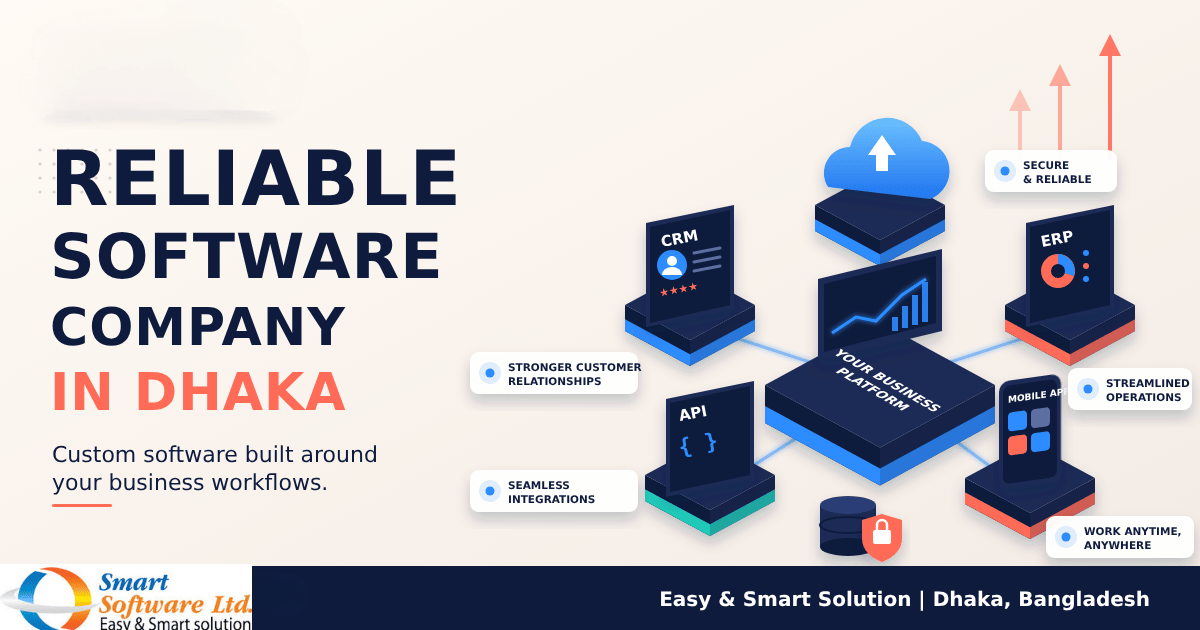
Reliable Software Company in Dhaka: 8 Tips to Choose
Choosing the right software development company is an important decision for any business. Whether you need a business website, a mobile application, custom software, or an enterprise resource planning (ERP) system, the right technology partner can help turn your ideas into practical digital solutions.
Dhaka, Bangladesh, has a growing technology and software development sector, offering businesses different options for building and maintaining software. However, not every company provides the same level of technical expertise, communication, project management, and ongoing support.
So, how can you find a reliable software company in Dhaka, Bangladesh?
In this guide, we will explain the key factors to consider, the questions to ask before hiring a developer, and how to choose a software partner that matches your business goals and budget.
Why Choosing the Right Software Company Matters
Software is more than a technical product. It can influence how a business manages customers, handles transactions, organizes information, and delivers services.
Working with the right development partner can help businesses:
- Improve operational efficiency through digital solutions.
- Build software around specific business requirements.
- Reduce repetitive manual tasks.
- Improve customer experiences.
- Integrate existing systems and workflows.
- Maintain and expand software as business needs change.
On the other hand, unclear requirements, weak communication, poor testing, or inadequate maintenance can lead to delays and additional expenses.
That is why businesses should evaluate a software company's capabilities before signing a contract.
8 Tips to Find a Reliable Software Company in Dhaka
1. Define Your Project Requirements
Before contacting software companies, identify what you want to build and why you need it.
For example, your project might involve:
- Business website development
- E-commerce website development
- Custom business software
- Mobile application development
- ERP software implementation
- HR and payroll management software
- Inventory and accounting systems
- Existing software maintenance or modernization
Prepare a basic list of required features, intended users, business objectives, and expected outcomes.
You do not need a complete technical specification at the beginning. However, a clear understanding of the problem will help potential developers provide more relevant proposals and estimates.
2. Review the Company's Portfolio and Previous Projects
A company's portfolio can help you understand its technical capabilities and experience.
Look for projects that are similar to yours in terms of functionality, industry, complexity, or business purpose.
When reviewing a portfolio, consider:
- Whether the company has delivered comparable projects.
- Whether live websites or applications are available to review.
- Whether the projects provide a good user experience.
- Whether the company explains its role in each project.
- Whether the solution appears suitable for the stated business requirements.
If possible, request a demonstration or ask how the company handled technical challenges during a previous project.
A strong portfolio is useful evidence, but it should be considered alongside other factors such as client references, technical discussions, and project planning.
3. Evaluate Technical Expertise
The technology used for your project should match its requirements, complexity, performance needs, and future maintenance plans.
Depending on your project, you may need expertise in:
- Frontend development
- Backend development and APIs
- Database design
- Mobile application development
- Cloud infrastructure and deployment
- Cybersecurity
- Quality assurance and testing
- Software integration
Ask the company to explain its proposed technology stack and why it is appropriate for your project.
A reliable software partner should be able to discuss technical decisions in clear language rather than relying only on technical jargon.
4. Check Client Reviews and References
Client feedback can provide insight into how a company manages projects and maintains professional relationships.
Look for consistent feedback across credible review platforms, company references, and publicly available project information.
If possible, speak with a previous client and ask questions such as:
- Was the project delivered according to the agreed scope?
- How effectively did the team communicate?
- How were changes and unexpected problems handled?
- Was the final software tested properly?
- Was support available after delivery?
Do not rely on a single review or testimonial. Consider the overall evidence before making a decision.
5. Understand the Pricing and Payment Structure
Software development costs vary depending on project scope, complexity, technology, team size, integration requirements, and maintenance needs.
Some projects may use a fixed-price model, while others may be billed based on time and materials or an agreed ongoing arrangement.
Before choosing a company, request a written proposal covering:
- Project scope and deliverables
- Development milestones
- Estimated timeline
- Payment schedule
- Included revisions
- Testing and deployment
- Maintenance and support
- Additional charges for scope changes
The lowest quotation is not necessarily the most economical choice. A realistic proposal should explain what is included, what is excluded, and how additional work will be handled.
6. Evaluate Communication and Project Management
Clear communication is essential for successful software development.
Before hiring a company, find out who will manage your project, how progress will be reported, and how you can provide feedback.
Useful project management practices may include:
- A designated project manager or point of contact
- Regular progress updates
- Documented requirements
- Task and milestone tracking
- Scheduled demonstrations
- A defined process for approving changes
- Clear procedures for reporting problems
These practices help keep both parties aligned and reduce misunderstandings during development.
7. Check Security, Testing, and Quality Assurance
Software quality should be considered throughout development, not just before launch.
Ask how the company approaches testing, data protection, access control, and vulnerability management.
Depending on your project, important considerations may include:
- Functional testing
- Performance and usability testing
- Security testing
- Backup and recovery procedures
- Role-based access control
- Secure handling of sensitive data
- Documentation and error monitoring
If the software handles financial, customer, or employee information, clarify how data will be protected and who will have access to it.
A reliable company should explain its testing and security practices in a way that fits the risks of your project.
8. Confirm Post-Launch Support and Maintenance
Software often needs updates after launch. Bugs may need fixing, operating systems and dependencies may change, and business requirements may evolve.
Before signing an agreement, clarify:
- How long post-launch support will last.
- Which types of bug fixes are included.
- Whether maintenance is included in the project cost.
- How updates and security patches are handled.
- How quickly support requests are acknowledged.
- Who owns the source code and related project assets.
- How the software can be transferred to another provider if necessary.
A clear maintenance agreement helps prevent confusion after the initial development work is completed.
Questions to Ask Before Hiring a Software Company
Before making your final decision, consider asking the following questions:
- Have you completed projects similar to ours?
- What technology stack do you recommend, and why?
- Who will manage the project and communicate with us?
- What are the project milestones and estimated timeline?
- How will you handle changes to the requirements?
- What testing and security procedures do you follow?
- Will we own the source code and project documentation?
- What happens if the project is delayed?
- What support and maintenance services are available after launch?
- Can you provide relevant client references or project demonstrations?
The answers can help you compare potential partners more objectively.
Software Company vs. Freelance Developer: Which Is Better?
Both software companies and freelance developers can be suitable, depending on the project.
| Factor | Software company | Freelance developer |
|---|---|---|
| Team structure | May provide developers, testers, designers, and project managers | Usually one individual, sometimes with subcontractors |
| Project size | Often suitable for larger or multidisciplinary projects | Often suitable for smaller or clearly defined tasks |
| Project management | May have established processes and dedicated management | Depends on the freelancer's working approach |
| Cost structure | May include team and organizational overhead | May have lower overhead, depending on the arrangement |
| Ongoing support | May offer formal maintenance arrangements | Depends on availability and contract terms |
| Accountability | Defined through company agreements and project processes | Defined through the individual contract |
Neither option is automatically better. The right choice depends on your project's complexity, budget, timeline, and need for ongoing support.
How Much Does Software Development Cost in Dhaka?
There is no single price for software development in Dhaka. The cost depends on what needs to be built and how much work is required.
For example, a basic informational website generally requires a different level of effort than a custom ERP platform with accounting, inventory, HR, and reporting modules.
Factors affecting the total cost include:
- Number and complexity of features
- UI/UX design requirements
- Third-party integrations
- Data migration
- Security and compliance needs
- Testing and quality assurance
- Deployment and hosting
- Training and documentation
- Ongoing maintenance
To receive a useful quotation, provide shortlisted companies with the same project requirements. This makes their proposals easier to compare.
Avoid choosing a provider based solely on an estimated price without reviewing the scope, deliverables, support, and contractual terms. For typical budget ranges and cost factors, see our guide to custom software development cost in Bangladesh.
Why Businesses Consider Custom Software and ERP Solutions
Off-the-shelf software can work well when a business has standard requirements. However, some organizations need more flexibility or integration between departments.
Custom software can be designed around specific business workflows, while ERP software can connect multiple functions within a shared system.
Depending on the solution, ERP modules may include:
- Sales management
- Inventory management
- Accounting and finance
- Purchasing
- Human resource management
- Payroll
- Production management
- Business reporting
For example, a business that manages sales, inventory, and accounting separately may benefit from integrating these processes. This can reduce duplicate data entry and improve consistency across departments.
The decision should depend on business requirements, implementation effort, integration needs, and long-term costs, not simply the number of available features.
Smart Software Ltd.: A Software Company to Explore in Bangladesh
Businesses researching software development companies in Bangladesh can explore Smart Software Ltd. to learn about its software solutions and services.
Smart Software Ltd. offers business software solutions, including Smart ERP, which supports business functions such as sales, inventory, accounts, HR, purchasing, and production, depending on the modules implemented.
For businesses looking to organize their operations through integrated software, it can be useful to review the available solutions and discuss specific requirements with the provider.
Before making a decision, businesses should evaluate the company's relevant experience, technical capabilities, implementation approach, support arrangements, and suitability for their project.
Learn more through the official website:
- Smart Software Ltd.: www.smartsoftware.com.bd
- Smart ERP: Smart ERP Software
- Software development services: Custom Software Development
Contact the company to discuss your requirements, request a demonstration where available, and understand which solution may fit your business needs.
Common Mistakes to Avoid When Choosing a Software Company
Even with careful research, businesses can make mistakes when selecting a development partner.
Choosing only by price: A low initial quotation may not cover essential features, testing, or maintenance.
Ignoring the contract: Make sure scope, payment terms, ownership, timelines, and support responsibilities are documented.
Skipping technical discussions: Confirm that the proposed solution can meet your functional and technical requirements.
Overlooking security: Discuss data protection, access controls, backups, and security updates before development begins.
Failing to plan for maintenance: Establish who will maintain the software and how future changes will be handled.
Accepting vague timelines: Ask for milestones, dependencies, and a process for managing delays.
A structured selection process helps businesses reduce avoidable risks and build a stronger working relationship with their software partner.
Frequently Asked Questions
1. How do I find a reliable software company in Dhaka?
Start by defining your requirements, reviewing company portfolios, checking client references, evaluating technical expertise, comparing written proposals, and confirming post-launch support.
2. What services do software companies in Dhaka provide?
Depending on their expertise, software companies may offer website development, mobile applications, custom software, ERP systems, integrations, cloud solutions, and software maintenance.
3. How much does it cost to hire a software company in Bangladesh?
Costs vary according to project complexity, features, integrations, design, testing, and maintenance requirements. Request a detailed proposal based on your actual requirements.
4. Should I choose a local software company?
A local company may make in-person meetings, communication, and understanding of local business needs easier. However, you should also evaluate its technical expertise, delivery process, references, and support capabilities.
5. What should a software development contract include?
It should clearly define the project scope, deliverables, milestones, payment terms, ownership of source code, confidentiality, data protection, change requests, acceptance criteria, and maintenance responsibilities.
6. Why is post-launch support important?
Software may require bug fixes, updates, security patches, performance improvements, and new features after launch. A clear support arrangement helps keep the solution useful and reliable over time.
7. Is ERP software suitable for small and medium-sized businesses?
It can be, especially when a business needs to connect multiple functions such as accounting, sales, inventory, and HR. The right choice depends on the organization's requirements, budget, and implementation readiness.
Conclusion
Finding a reliable software company in Dhaka, Bangladesh, requires more than comparing prices or looking at attractive websites. Businesses should evaluate technical expertise, relevant project experience, communication, project management, security, contractual clarity, and long-term support.
Start with clearly defined requirements, compare proposals on equal terms, and ask detailed questions before signing an agreement. Taking these steps can help you choose a technology partner that understands your goals and can support your business as it grows.
If you are exploring business software or ERP solutions, visit Smart Software Ltd. to learn more about its offerings and discuss your organization's software requirements.
 Best Jobs Site In Bangladesh - BDJobs Live. Best Online Recruitment Platform in Bangladesh
New Comment